Coffee Board of India, The Agency Fund, OpenAI and Center for Global Development, as part of the AI for Global Development Accelerator
AI in Digital Advisory Generation
Smallholder farmers make high-stakes decisions under tight time and information constraints. Precision Development (PxD) is building and testing an AI-enabled approach to deliver timely, hyper-local agricultural guidance in formats farmers are already familiar with and can easily use.
Existing digital advisory systems rely on a team of agronomists, data scientists and behavioral scientists to analyze multiple complex dimensions, such as weather, soil, crop stage, pests, and farmer information to generate relevant and locally contextualized recommendations. While effective, this approach is not pragmatic in providing highly customized, granular advice at the scale of millions of smallholder farmers. AI can process vast and diverse datasets in real time, generating hyper-local, actionable guidance that reaches each farmer in a timely and context-specific way.
PaddyAI: A new AI Assistant for Agricultural Advisories

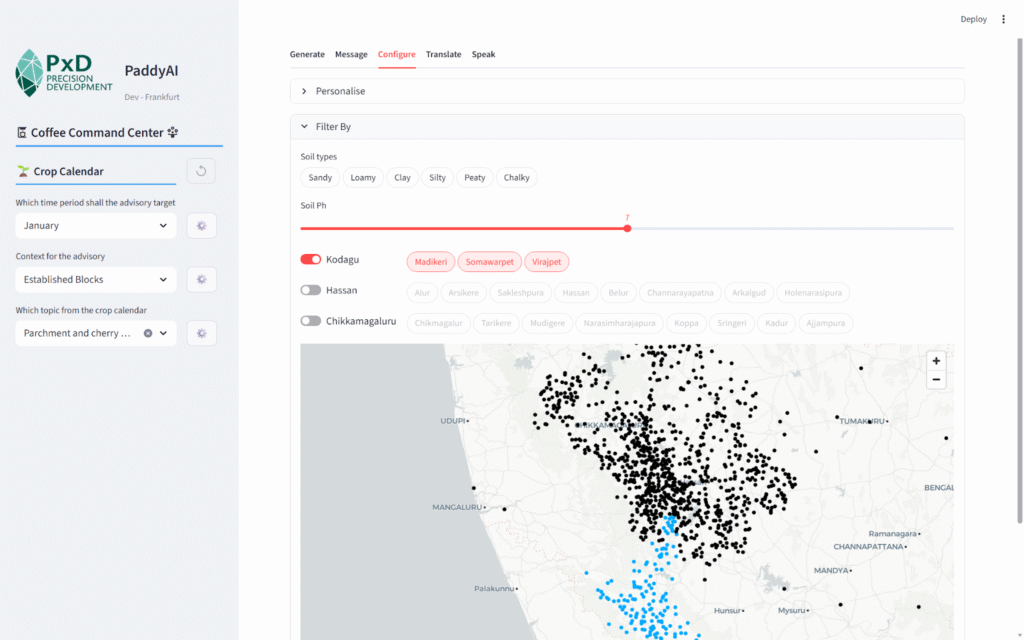
Precision Development (PxD)’s Service Delivery team is building PaddyAI, an AI Assistant that helps agronomists and service delivery teams create and deliver personalized farming advice at scale. The system is designed to work as an intelligent assistant – not a chatbot – that follows agronomists’ expert guidance to generate timely agricultural advisories based on agronomist-provided knowledge (crop calendars, best practices, seasonal guidance) and customized for individual farmer circumstances and behaviours (crop type, farm size, local weather conditions, communication preferences). The system translates advisories into local languages with appropriate cultural nuances and then can convert text into audio messages for delivery through our mobile communications platform – Paddy – for any dissemination channel, including SMS, voice, chatbots, or apps. Rather than replacing existing advisory systems, PaddyAI enhances them, enabling higher quality and deeper customization while keeping delivery simple and accessible for farmers, critically without requiring a farmer to have a smartphone.
Considerable value comes at scale: when reaching thousands (or even millions) of farmers with different profiles and preferences, PaddyAI can rapidly incorporate real-time data and produce the many customized, translated versions of each voice message that are needed, a task that would be impossible for agronomists to do manually, without incurring significant costs and potentially impacting quality and timeliness. Instead of categorizing farmers into 10s of segments and customizing advisory messages for 1000s of farmers in each segment, PaddyAI would allow us to categorize farmers into 1000s of segments and customize messages for 10s of farmers in each segment. The agronomy and service delivery teams continue to retain oversight – serving as a human in the loop – to ensure the advisory that goes out to farmers is appropriate. A process that once took months could now take mere days to develop quality hyper-customized advice for a huge, diverse population of tens of millions of farmers across an entire agricultural season!
PxD’s service development team is piloting PaddyAI to support our Coffee Krushi Taranga (CKT) service that provides smallholder coffee farmers in Karnataka, India with actionable and timely advice. PaddyAI is already supporting the team behind the service by designing and testing advisories translated into Kannada and converted into audio outputs sent directly to farmers as voice calls. This ensures that farmers continue to receive timely, actionable guidance in ways they can easily understand and use, while allowing for increased personalization at scale.
Testing and Iteration
PxD’s approach to scaling services that maximize impact for farmers relies on gathering regular farmer feedback, and iteratively testing and improving the service as we scale. We have tested early versions of the advice generated by PaddyAI with farmer focus group discussions to assess comprehension and preferences. Through close collaboration with agronomists, extension workers, and more farmers, we are continuously refining the PaddyAI system – for example, by fine-tuning the translation of agronomic terms to local context – to ensure that the recommendations are clear, actionable, and relevant to local contexts. This approach ensures solutions are effective, accessible, and ready for broader rollout.
PxD is applying key elements of the Agency Fund’s AI Evaluation Framework for the Development Sector to implement a logical sequence of structured testing of PaddyAI. Aligned with the Level 2 and 3 stage of product evaluation, we are running rapid user-engagement experiments using automatically generated platform data to assess how users engage with agricultural advisory phone calls that were assisted by PaddyAI and also measure recall and retention. Together with The Agency Fund, PxD is implementing a series of A/B tests – comparing service variations to identify which performs better – to test how using AI to script, record, and customize advisory messages influence user engagement, comprehension and adoption. Our first experiment tested whether AI-generated and voiced advisories have similar user engagement compared to human-generated and voiced advisory content delivered through the CKT service. In the next phase, we will test the use of AI in customizing advisory messages using real-time data like farmer preferences or weather information to assess the value of increased personalization now made possible through PaddyAI.
The Road Ahead
Building on the pilot of PaddyAI with coffee farmers, PxD plans to expand AI-powered advisories across multiple crops and geographies, and expand the types of features offered to boost engagement and trust with farmers. Key priorities include:
Adding real-time intelligence to our existing inbound hotline system, so farmers can call anytime and get AI-supported responses on demand.
Integrating hyper-local information—like weather, pest alerts, soil conditions—for hyper-customized advisories.
Expanding language capabilities beyond Kannada to Tamil, Telugu, and Malayalam.
Scaling geographically and across value chains, potentially starting with Nigeria.
From our blog

Make an Impact Today